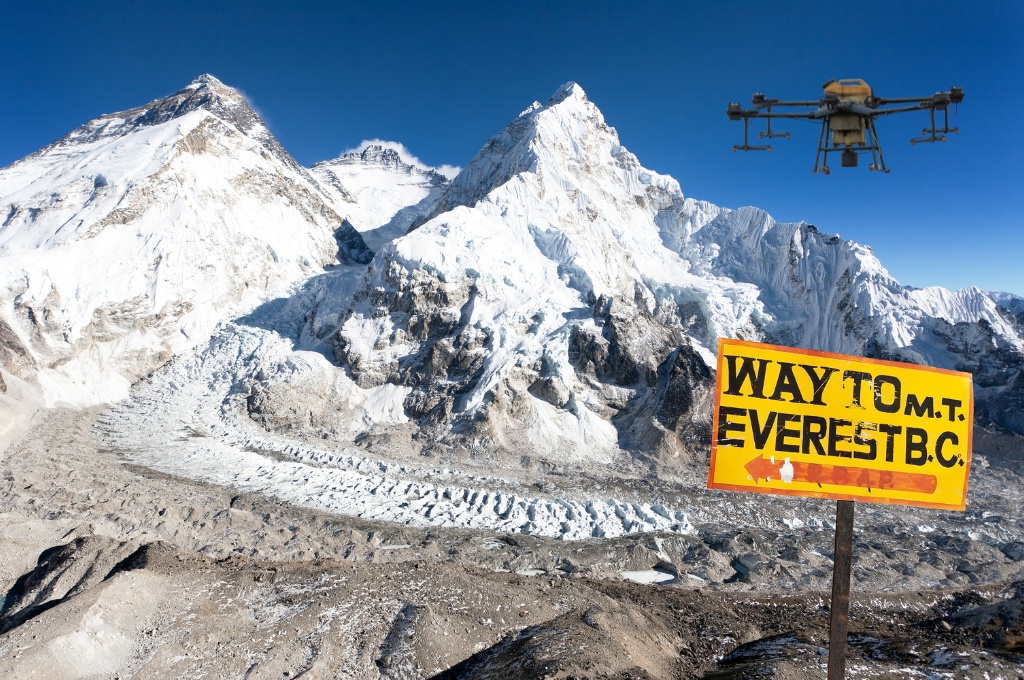
For seven decades, the only sounds that pierced the silence of Everest Base Camp were the crunch of crampons on ice, the howl of Himalayan winds, and the distant thunder of avalanches. In 2026, a new sound has joined them: the quiet, purposeful whirr of drone rotors.
The Everest Base Camp trek — one of the most popular high-altitude adventures on Earth — is undergoing a quiet revolution. Drones, AI-powered weather systems, satellite communication devices, and smart wearables are no longer curiosities on the trail. They are becoming essential infrastructure, changing how Sherpas work, how trekkers stay safe, and how Nepal manages its most iconic mountain.
This guide covers everything you need to know about technology's expanding role in the Everest Base Camp experience in 2026, from the game-changing cargo drones operating in the deadly Khumbu Icefall to the smartwatch on your wrist as you walk into Namche Bazaar.
The Khumbu Icefall — the chaotic, crevasse-riddled glacier between Base Camp (5,364 m) and Camp 1 (6,065 m) — has claimed nearly 50 lives since 1953. It is the most dangerous passage on Everest, and traditionally, everything that went through it was carried on the backs of Sherpa Icefall Doctors: ropes, ladders, oxygen cylinders, food, and medical supplies, each requiring a brutal six-to-seven-hour climb.
That is changing fast. Kathmandu-based company Airlift Technology, flying DJI FlyCart 30 heavy-lift drones, completed the first full-scale commercial drone logistics mission on Everest during the 2025 spring climbing season. Over 25 days of operations, the two drones transported 1,259 kg of supplies — including 444 kg of rope and ladders for the Icefall Doctors, 900 kg of high-camp equipment, and 150 oxygen cylinders — in trips that took just 6 to 12 minutes each.
The FlyCart 30 can carry up to 20 kg per flight and maintained stability at −15°C temperatures, in low-oxygen conditions and high winds — conditions that would ground most conventional aircraft. Each drone costs approximately $70,000, but operators expect prices to fall as the technology matures and demand increases.
The process is a precise collaboration between Sherpas and drone pilots. A small scouting drone first flies ahead to map the safest route. Sherpas then ascend the icefall as they always have, identifying where specific gear is needed. They radio GPS coordinates back to the pilot at Base Camp, who flies supplies in on the heavy-lift drone using a self-detaching winch system — critical in terrain where the drone often cannot safely land.
This human-machine partnership is a defining feature of the technology's success on Everest. It does not eliminate Sherpa expertise — it amplifies it.
Everest has earned the grim nickname "the world's highest dumpsite." Decades of expeditions have left behind over 80 tonnes of garbage across its slopes — empty oxygen bottles, discarded climbing gear, food packaging, and human waste. Removing this refuse used to mean helicopters (expensive, altitude-limited) or human porters (dangerous and slow). Now drones are filling the critical middle ground.
During the 2025 season, Airlift Technology's drones removed 300 kg of waste from Camp 1 — a task that required over 40 individual flights. Rather than carrying the maximum payload of 30 kg, the team limited loads to 20 kg per trip to ensure stability and flight safety at extreme altitude. After demonstrating success on Everest, the company went on to remove 641 kg of waste from nearby Mount Ama Dablam.
2026 ENVIRONMENTAL RULE FOR TREKKERS & CLIMBERS
Nepal's Department of Tourism now mandates that each climber must bring down 2 kg of waste from Camp 2 and above, using government-issued WAG bags. Drone-assisted collection is expected to complement this rule by handling high-camp waste that individuals cannot safely carry down.
Local officials in the Khumbu Pasang Lhamu Rural Municipality are now working to scale drone-assisted cleanup across other peaks in the region, and are actively training local Sherpas as certified drone operators — a significant shift in career pathways for mountain communities.
Beyond cargo and waste, drones are making a powerful case in search and rescue on Everest. When a trekker or climber goes off-route or suffers an emergency at altitude, response times measured in hours can mean the difference between life and death. Drones can locate a missing person in minutes using thermal imaging and GPS, relaying real-time information to ground rescue teams.
Airlift Technology has identified search and rescue as one of its primary development priorities for the 2026 season. The company also disclosed that drones may be used for body retrieval — over 300 climbers' remains lie on Everest's slopes, many deemed permanently unrecoverable. Drone recovery missions could bring closure to families while eliminating the enormous risk currently placed on human recovery teams.
One tragic case highlighted the urgency: on Annapurna during the 2025 season, two Sherpas — Gnima Tashi and Rima Sherpa — died in an avalanche while manually carrying oxygen between high camps. "If drones had been used, those lives would have been spared," said Raj Bikram Maharjan, CEO of Airlift Technology.
One of the most remarkable stories of drone innovation on Everest came in 2025, when Polish skier Andrzej Bargiel completed a no-oxygen ski descent of Everest — guided in real time through the treacherous Khumbu Icefall by his brother Bartek, who flew a drone overhead from Base Camp, calling out route updates by radio. It was a vivid demonstration that drones are no longer just documenting Everest — they are actively participating in human achievement on the mountain.
For trekkers heading to Base Camp rather than the summit, the benefits are subtler but still significant. Digital trail apps now integrate real-time weather data from high-resolution Himalayan weather models. Platforms like Windy and Mountain Forecast give trekkers and guides granular forecasts updated every hour, dramatically improving the ability to time acclimatisation days, rest days, and the final push to Base Camp at 5,364 metres.
You do not need to be a drone pilot or expedition climber to benefit from technology on the Everest Base Camp trek. The trekking experience in 2026 is shaped by a constellation of smart devices and digital tools that every trekker carries or encounters along the trail.
Garmin inReach and Zoleo satellite messengers have become standard-issue for serious EBC trekkers. These devices allow two-way messaging anywhere on the planet via satellite, with no cellular connection required — critical when you are three days' walk above Lukla and cellular networks drop out entirely. Many trekking companies now require clients to carry these devices.
Smartwatches from Garmin, Suunto, and Apple Watch Ultra now include pulse oximetry (blood oxygen saturation monitoring), which is genuinely useful at altitude. Acute Mountain Sickness (AMS) is the primary medical risk on the EBC trek, and low SpO₂ readings — generally below 80% on rest — are an early warning sign that a trekker needs to descend or acclimatise further. Many trekking doctors on the trail now routinely check trekkers' wearable data alongside manual oximeter readings.
Gone are the days of relying solely on weather windows delivered by expensive forecasting services to summit teams. AI-driven models now provide remarkably accurate 7–10 day forecasts for the Khumbu Valley, accessible free or cheaply via smartphone. Trekking guides use these forecasts to optimise rest days at Namche Bazaar (3,440 m) and Dingboche (4,410 m) — the critical acclimatisation stops — rather than following fixed itineraries that ignore weather patterns.
The Himalayan Rescue Association clinic at Pheriche (4,371 m) now supplements in-person consultations with telemedicine capabilities along with that Nepal Lion Treks provides a telemedicine suitcase from Aarogya Nepal tech, allowing trekkers to consult with altitude, and healt specialists with guide or Kathmandu remotely. Several trekking companies have begun integrating telemedicine apps into their guided treks, ensuring medical advice is available even if the trekker is at Gorak Shep (5,164 m) on a poor-weather day.